Beyond the Hype: AI Can Automate 12% of Work Today. Is Your Organization Ready for the Reality?
This post is inspired by the episode, Can today's AI replace 12% of work? of the AI Daily Brief.
The Iceberg Below the Surface: A New Look at AI and Automation
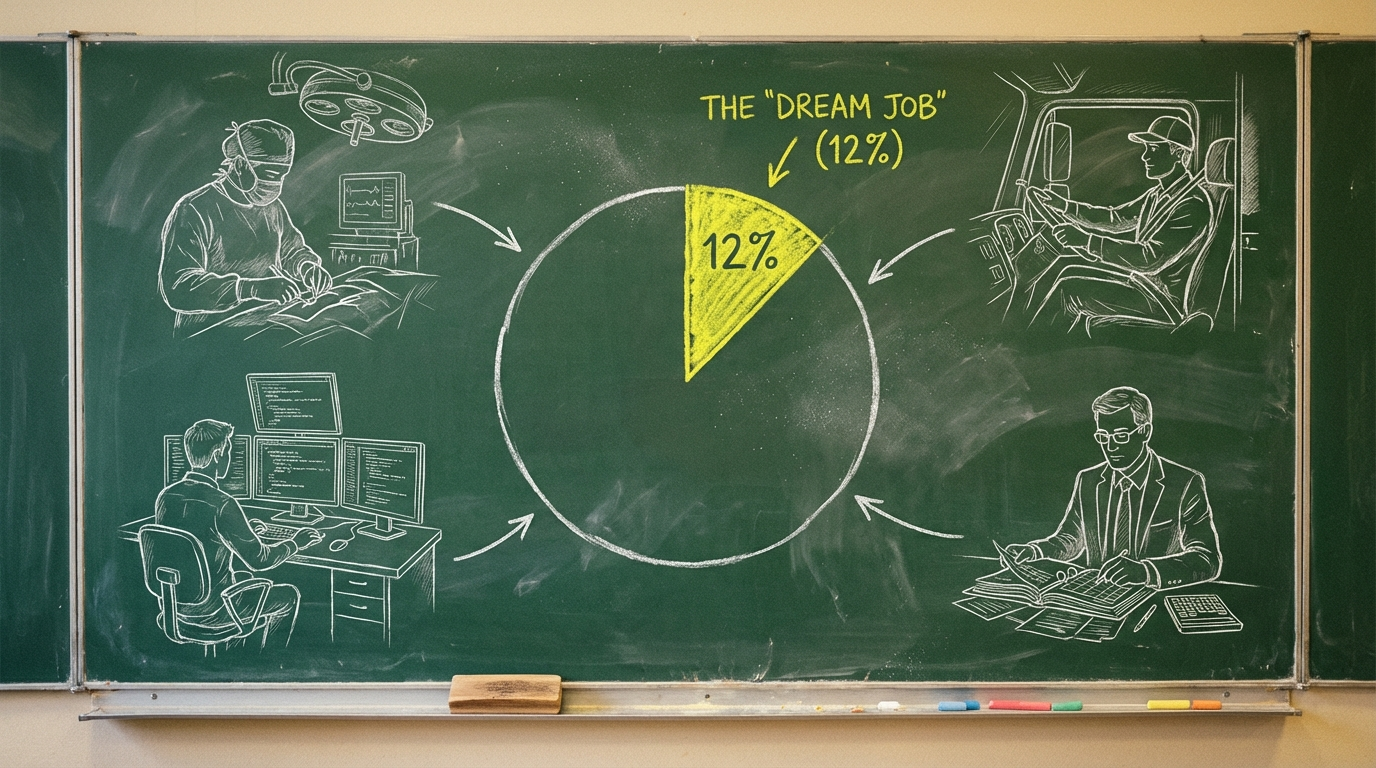
In a recent AI Daily Brief podcast, a groundbreaking study from MIT, known as Project Iceberg, was highlighted, offering a sobering new perspective on AI's real-world capabilities. The study's "Iceberg Index" simulates the entire U.S. labor market and concludes that today's AI systems have the technical ability to automate skills equivalent to 11.7% of the nation's wage value. This isn't a prediction about future job losses; it's a measure of the technical potential that exists right now, much of it hidden beneath the surface of mainstream adoption in cognitive fields like finance, HR, and professional services.
This finding moves the conversation beyond the visible "tip of the iceberg", the 2.2% of automation seen in software development, and reveals a massive, submerged opportunity. It underscores a critical distinction for leaders: the gap between what AI can do and what organizations are prepared to implement is vast and fraught with both opportunity and peril.
From Technical Capability to Business Value: The Enterprise Execution Gap
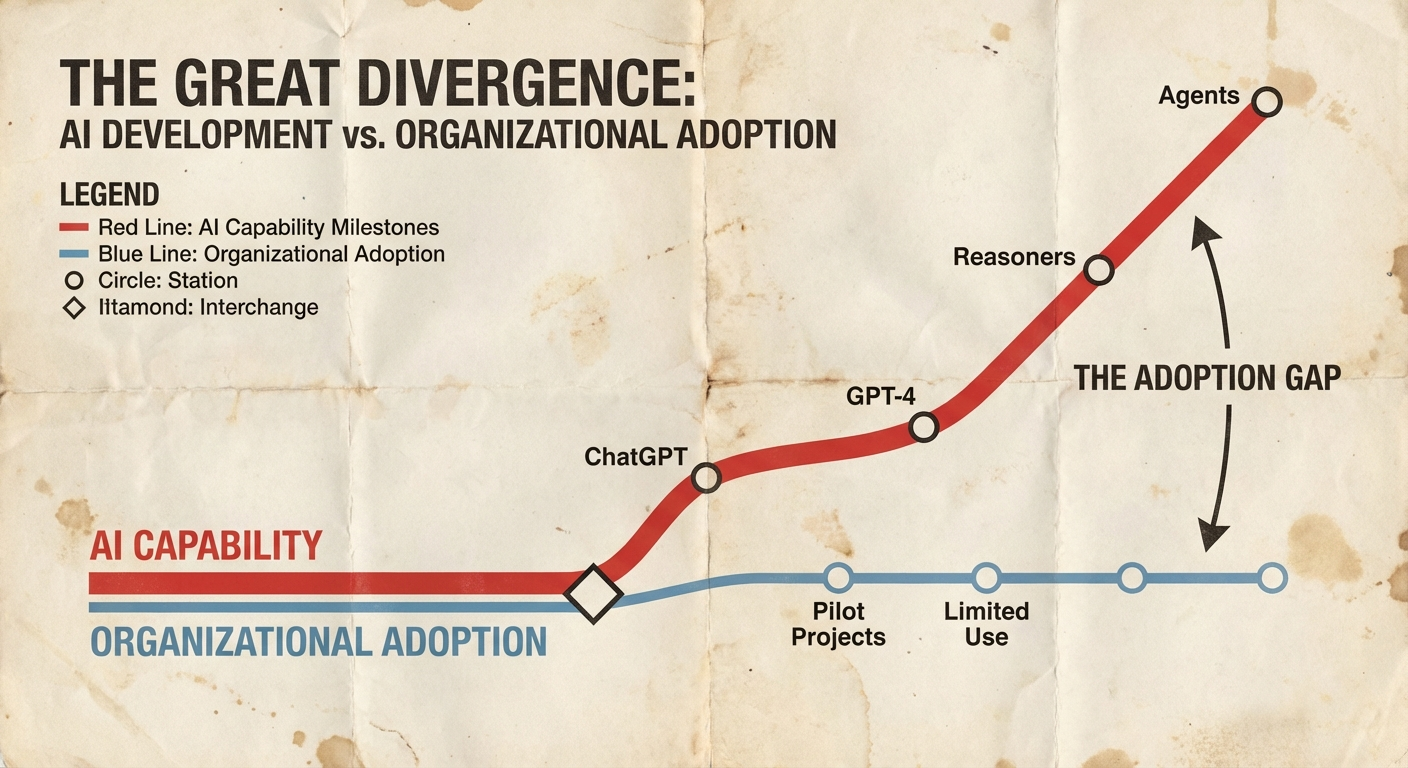
The MIT study provides the "what," but for enterprise leaders, the "how" is far more complex. While benchmarks like OpenAI's GDPval demonstrate that frontier models can match or exceed human expert performance on nearly half of all economically valuable tasks, the path from technical proof to scalable business impact is not straightforward. The reality is that most organizations are struggling to cross this chasm.
Recent industry data reveals a significant execution gap. While over 70% of organizations have introduced generative AI, a mere 6% have implemented advanced, agentic AI at scale. The primary barriers are not model limitations but organizational friction: 46% cite integration with existing systems, 42% point to data quality and access issues, and 40% are stalled by security and compliance concerns. This has led to a landscape where 41% of companies are mere "spectators," with little to show for their AI investments.
The era of blank-check pilots is over. The new imperative is to connect AI's profound capabilities to tangible ROI. This requires moving beyond isolated use cases and addressing the foundational challenges of enterprise AI adoption. The competitive advantage will not go to the companies that simply buy the best models, but to those that build the organizational capacity to deploy them effectively, securely, and at scale.
Key Questions for Your Leadership Team
The gap between AI's potential and today's operational reality should prompt urgent, strategic conversations in every boardroom. These are the questions that separate prepared organizations from those that will be disrupted:
- Beyond the Pilot: Do we have a clear, enterprise-wide view of which specific skills and processes are most exposed to automation, and what is the true dollar value of that exposure to our P&L?
- The Data Foundation: Is our data architecture ready to support scalable AI, or are we still wrestling with siloed, low-quality data that will cripple any attempt at meaningful deployment?
- The Human + AI Operating Model: How will we redesign workflows and retrain our people to work alongside intelligent agents, and how do we manage the risk of skill atrophy in critical roles?
- Governance at Speed: Are our risk, security, and compliance frameworks agile enough to govern agentic AI workflows, or will they become a bottleneck that cedes ground to more nimble competitors?
- Measuring What Matters: Do we have a clear methodology to measure the ROI of our AI initiatives, moving beyond productivity metrics to track true business value creation?
How Leading Organizations Find Answers
The questions above can feel daunting, but they are not unanswerable. In our work with enterprise clients, we've observed a clear pattern: the organizations that successfully navigate AI transformation don't just buy technology; they build a strategic framework that aligns their people, processes, and data with their ambitions.
They move from ad-hoc exploration to a structured, holistic assessment of their capabilities. They create a common language for the executive team to debate and prioritize. Most importantly, they get an objective, data-driven baseline of where they are today before they try to build for tomorrow.
This is the philosophy we've codified into our AI Readiness Audit. It's not a product pitch; it's a diagnostic process designed to provide the objective clarity that leadership teams need to move forward with confidence. It allows organizations to systematically uncover their unique blockers and identify their highest-impact opportunities.
Continue the Conversation
Every organization's journey with AI is unique. If the questions and challenges discussed in this post resonate with your team, we welcome a conversation. Our goal is to help leaders build a clear, actionable roadmap.
To learn more about how a structured assessment can de-risk your AI investment and accelerate your path to value, you can explore our approach at besuper.ai or reach out to our team to discuss your specific situation.
This post is based on Can today's AI replace 12% of work? from AI Daily Brief.