Why Most Companies Are Still in the AI Water Wheel Phase
This post is inspired by the episode, Work in the Age of Infinite Agents of the AI Daily Brief. Here’s how it connects to Superintelligent:
- Water Wheel Phase: Figuring out which workflows to redesign vs. which to simply automate is exactly the kind of prioritization our assessments help with. Most organizations need a structured way to see where they actually stand before they can make that leap.
- Context Fragmentation: The context fragmentation problem is real, and before organizations can solve it, they need to understand where their critical knowledge actually lives and which workflows are most affected. That's discovery at scale.
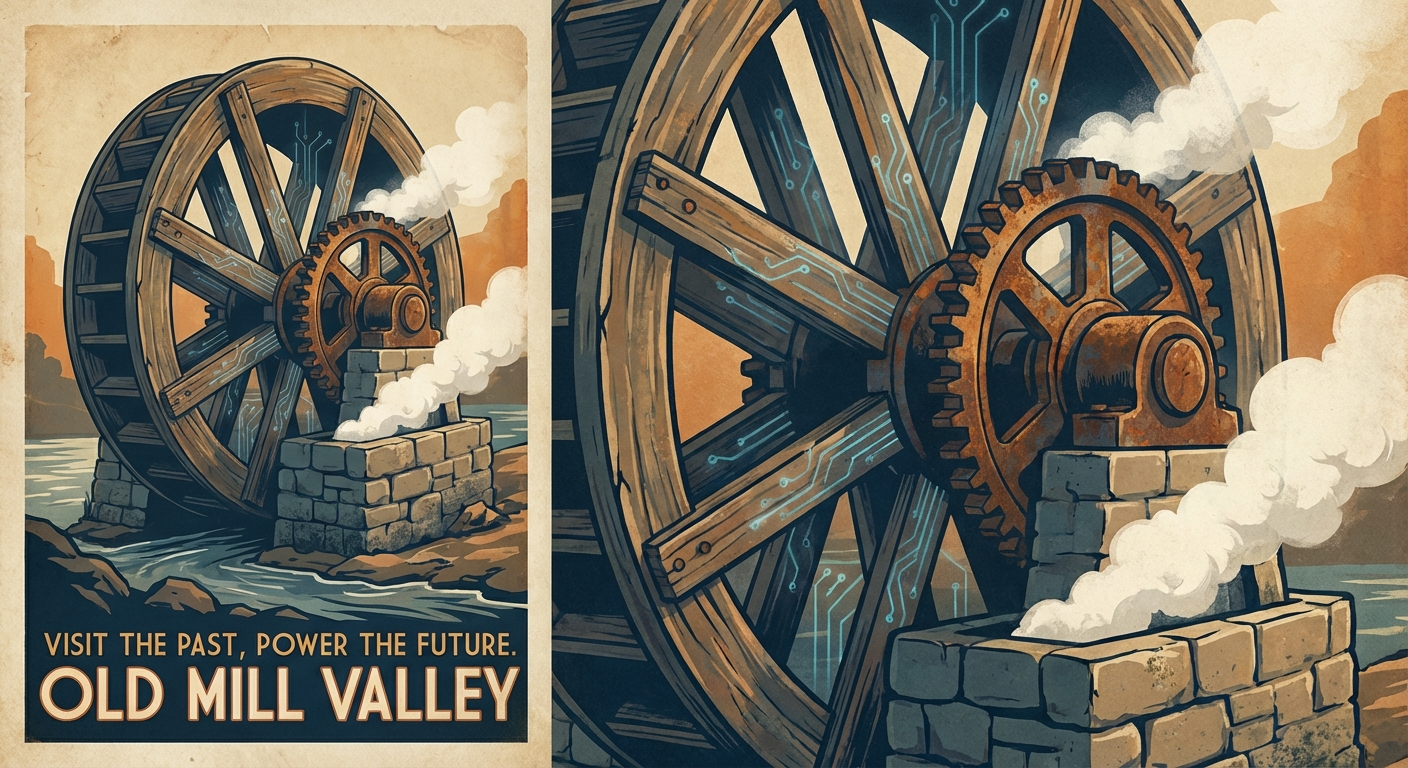
Most organizations are making the same mistake with AI that early industrial companies made with steam engines. They're swapping out the water wheel but keeping everything else the same. The result? Modest productivity gains instead of the transformation everyone expected.
The CEO of Notion, Ivan Jao, puts it perfectly: we're still in the "water wheel phase" of AI adoption. Companies are bolting chatbots onto existing workflows, adding AI features to current tools, and expecting magic to happen. But real transformation requires something much harder: completely rethinking how work gets done.
The Water Wheel Trap Every Executive Falls Into
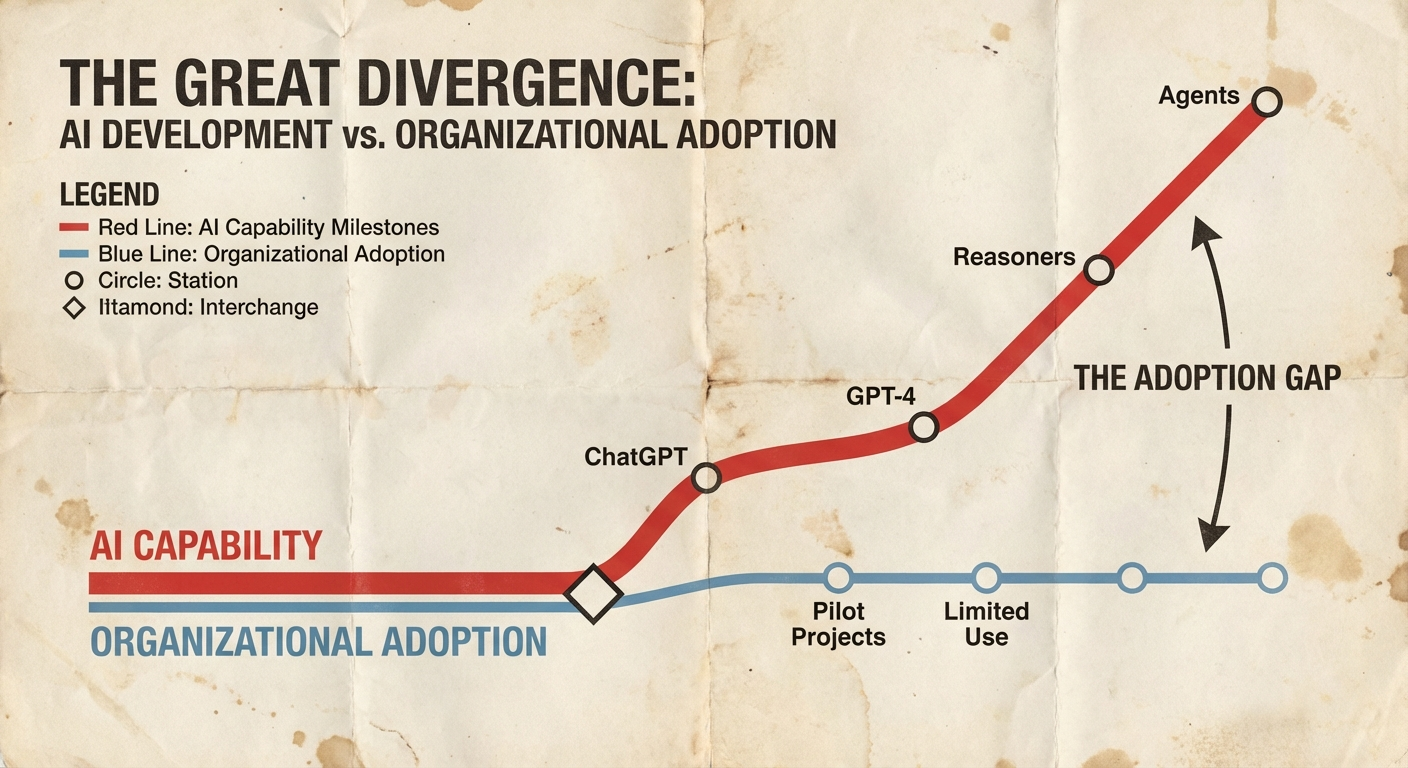
Here's the pattern playing out in boardrooms everywhere. Leadership gets excited about AI, pilots a few chatbots, maybe adds some AI features to existing software, then wonders why productivity hasn't exploded. Sound familiar?
This is exactly what happened when steam engines first arrived. Early textile factories simply replaced their water wheels with steam engines and kept their factory layout identical. Productivity gains were modest at best.
The breakthrough came when factory owners realized they could decouple from water entirely. They built larger mills closer to workers and ports. They redesigned their entire factory around steam power instead of just swapping out the engine. That's when the second industrial revolution really took off.
Most companies today are making the same mistake. They're treating AI like a better water wheel instead of asking the fundamental question: what would we build if we started from scratch?
Why Context Fragmentation Kills AI Transformation
There's a deeper reason why most AI implementations feel underwhelming. The problem isn't the technology; it's how our work is structured.
Consider what happens when an AI agent tries to help with something as basic as drafting a product brief. It needs information from Slack conversations, strategy documents, last quarter's dashboard metrics, and institutional knowledge that lives only in someone's head. Right now, humans are the glue stitching all that context together through copy-paste and browser tab switching.
For coding, this problem doesn't exist. Development tools and context live in one place: the IDE, the repository, the terminal. That's why we're seeing programmers become 30-40x more productive with AI coding agents. The context is consolidated.
But general knowledge work is scattered across dozens of disconnected tools. Until that context gets consolidated, AI agents stay stuck in narrow use cases instead of transforming entire workflows.
The False Choice Between Automation and Job Displacement
Here's where most AI discussions go wrong. They assume AI is a zero-sum game where humans either get replaced or stay exactly the same. But Box CEO Aaron Levy points to a more interesting precedent: marketing.
In the 1970s, there were a few hundred thousand people in marketing-related jobs across the US. Today, it's in the low millions. Marketing employment increased five-fold over 50 years, at exactly the same time that technology made marketing work far more efficient.
What happened? Technology democratized marketing. It went from being something only the largest companies could afford to something every small business could participate in. CRM systems, analytics software, graphic design tools, and targeting platforms expanded the market for marketing work instead of shrinking it.
AI is following the same pattern across knowledge work. A 10-person services firm that could never justify building custom software can now prototype an app in days instead of months. The investment cost drops so dramatically that entirely new categories of work become viable.
This is Jevons Paradox applied to knowledge work: making something dramatically more efficient often increases total demand because it unlocks previously impossible use cases.
Why Enterprise Advantages Are Evaporating
For decades, large enterprises had built-in advantages. They could afford the best lawyers, marketers, and engineers. They could experiment on new ideas and effortlessly move resources between projects. This created a stark disadvantage for everyone else on day one, no matter what they did.
AI agents are changing that calculus. When you dramatically lower the cost of almost any organizational task, small companies suddenly have access to capabilities that used to be Fortune 500 territory.
Every entrepreneur knows how scarce resources are when running a business. Small teams constantly make trade-offs between having good marketing, building new product features, handling customer support, managing finance operations, and finding new distribution channels. These trade-offs hold back growth.
AI agents blow up the core constraint driving these trade-offs: the cost of doing these activities. Any consumer now has better access to education and tutoring than an aristocrat would have had 100 years ago. Soon, every business in the world will have access to the talent and resources of a Fortune 500 company.
The Real Work Starts After the Water Wheel Phase
So what does it actually look like to move beyond the water wheel phase? It means stopping asking AI to be merely a co-pilot and starting to imagine what knowledge work could look like when human organizations are reinforced with AI infrastructure.
At Notion, more than 700 AI agents now handle repetitive work across their 1,000 employees. They take meeting notes, synthesize tribal knowledge, field IT requests, log customer feedback, help with onboarding, and write status reports. But that's just baby steps.
The real gains come from fundamental workflow redesign. The weekly two-hour alignment meeting becomes a five-minute async review. Executive decisions that required three levels of approval happen in minutes. Companies can scale without the communication degradation we've accepted as inevitable.
This isn't about replacing humans. It's about leveraging AI infrastructure so humans can focus on higher-value work instead of being stuck in every loop as supervisors and quality checkers.
The Infrastructure Question No One's Asking
Most AI conversations focus on capabilities: what can these models do? But the more important question is infrastructure: how do we build workflows that take advantage of those capabilities?
Just like steel allowed buildings to rise dozens of stories by making human communication no longer be the load-bearing wall, AI can become steel for organizations. It can maintain context across workflows and surface decisions when needed, without the noise.
But this requires intentional design. You can't just add AI features to existing processes and expect transformation. You have to rethink the underlying architecture of how work gets done.
What This Means for Your Organization
If you're leading AI adoption in your organization, here's the uncomfortable truth: your pilots probably aren't failing because the technology isn't ready. They're failing because you're trying to optimize existing processes instead of designing new ones.
The companies that will win in the AI era are those that can imagine what they would build if they started from scratch. They'll ask questions like: What would our customer support look like if context wasn't fragmented across twelve different tools? What would product development look like if institutional knowledge was instantly accessible to everyone who needed it?
What would strategic planning look like if we could synthesize insights from all our data sources in real time? These aren't technology questions. They're design questions.
The next wave of AI transformation won't come from better models or more features. It will come from organizations brave enough to stop swapping out water wheels and start building something entirely new.
The steel and steam are here. The question is whether you're ready to use them to build the next skyline.
This post is based on Work in the Age of Infinite Agents from AI Daily Brief.