Skills for the Code AGI Era
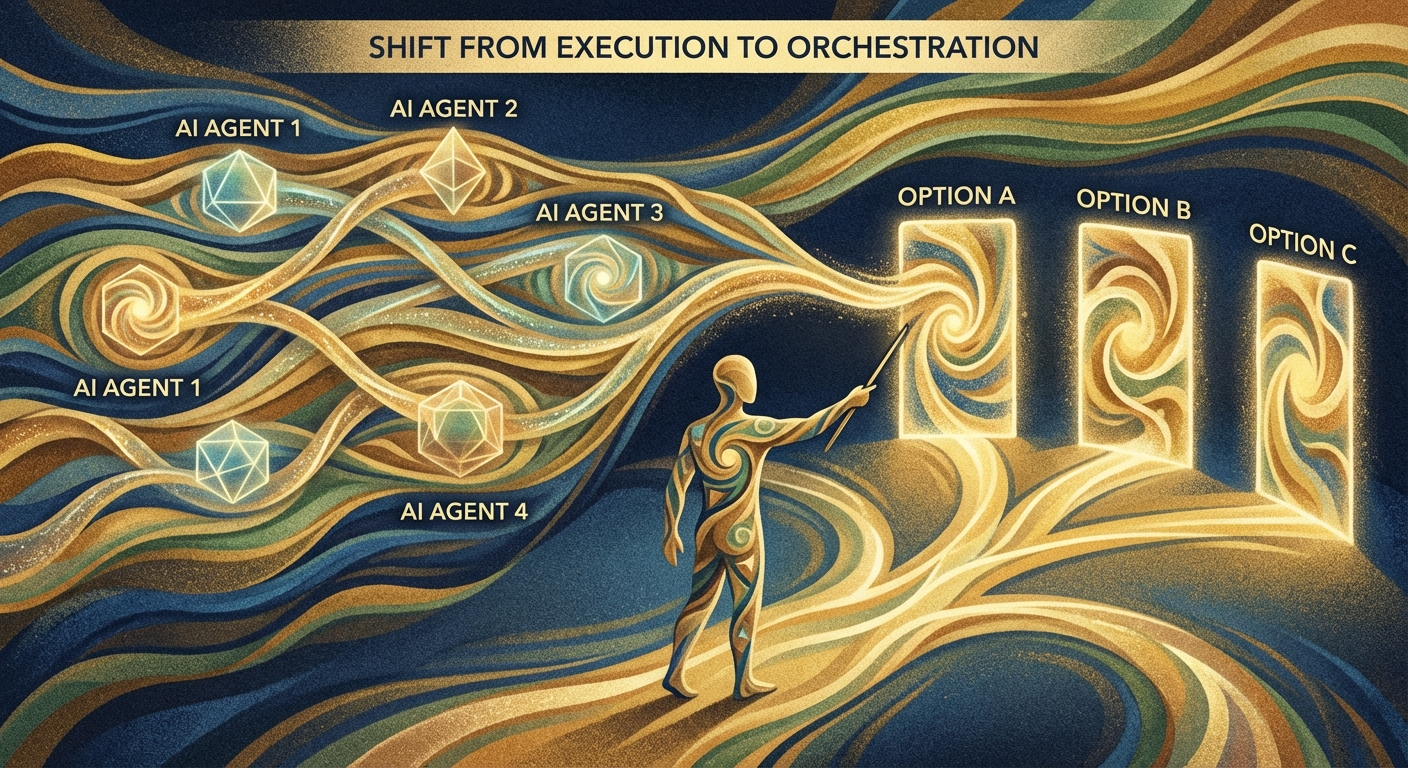
This post is inspired by the episode, Skills for the Code AGI era of the AI Daily Brief. Here’s how it connects to Superintelligent:
- Selection Over Execution: This is the core of what the readiness audit does. It doesn't build anything. It tells you what's worth building, in what order, and where your organization is actually ready to absorb the change.
- Capability Overhang: The audit is designed to quantify exactly this gap for your organization, department by department, and show you where the biggest leverage points are.
Execution is cheap now. Selection is scarce.
That's the fundamental inversion happening right now in enterprise work, and most organizations haven't internalized it yet. Nathan Lambert captured it in his essay "Get Good at Agents," and it explains why so many companies are stuck between AI enthusiasm and actual ROI.
The shift isn't technical. It's about knowing what to build, not how to build it. And that changes everything about the skills enterprises need to invest in for 2026 and beyond.
The Army, Not the Power Tool
Lambert describes the feeling clearly: "I no longer feel like just working hard will be a lasting edge when I can have multiple agents working productively in parallel on my projects. My role is shifting more to pointing the army rather than using the power tool."
This is happening faster in software engineering than anywhere else, but it's coming for every knowledge work function. The people who adapt fastest aren't the ones grinding harder. They're the ones redesigning how they work.
Two categories of skills matter now. Call them the Agent Manager and the Enterprise Operator. The first is about directing AI effectively. The second is about knowing what to direct it toward. The superpower is having both.
Why? Because knowing how work actually happens in a specific industry or function is scarce. Knowing what data sources matter, what compliance constraints exist, what workflows break under pressure, that's the context AI needs to be useful.
Domain experts who learn to manage agents will outperform generalist AI power users every time. Because they know which problems are worth solving and what "good enough" looks like in context.
Most companies built hiring pipelines, training programs, and career tracks around the assumption that execution was the bottleneck. You needed more engineers, more analysts, more PMs. You needed people who could do the work.
Now the bottleneck is direction. You need fewer people who can define the work, scope it correctly, prioritize it strategically, and orchestrate agents to execute it.
This is not about replacing people. It's about redeploying them. The junior analyst who spent 60% of their time pulling data and 40% interpreting it can now spend 95% of their time on interpretation and strategy. But only if they develop the agent manager skills to delegate the data work effectively.
The PM who spent half their time writing specs and coordinating across teams can now spend most of their time on product strategy and user research. But only if they learn to trust agents with the coordination work.
This transition is hard. It requires unlearning habits that were career-building for the last decade. It requires trusting systems that still make mistakes. It requires accepting that your edge is no longer grinding harder than the next person.
The Mentorship Gap
There's a second-order problem nobody's talking about yet: if domain experts stop executing, how do junior employees develop domain expertise?
The traditional path was apprenticeship. You did grunt work for two years, absorbed context, learned the unstated rules, built judgment. That path is breaking. If agents do the grunt work, juniors don't get the reps.
Some organizations will solve this with deliberate rotation programs. Six months managing agents on compliance work, six months on pricing strategy, six months on customer success. Others will lean into simulation and case study training. Some won't solve it at all and will wake up in 2028 with a missing generation of mid-level talent.
This is solvable, but it requires intentional design. And most organizations won't see it coming until it's a crisis.
What This Means for 2026
If you're building an AI strategy for 2026, the question isn't "what models should we use" or "what features should we pilot." It's "which skills do we need to develop in which roles, and how fast can we scale that training."
The agent manager skills, systems thinking, task scoping, async orchestration, validation at scale, those are trainable. But they're not intuitive. You need structured programs, not "figure it out as you go."
The enterprise operator skills, domain expertise, problem recognition, constraint mapping, those are harder to train but easier to identify. Find the people who already have them and invest in teaching them the agent manager half.
The companies that do this work in Q1 and Q2 will have a functional AI-augmented workforce by Q4. The ones that wait for the technology to get easier are going to lose talent to competitors who moved faster.
This post is based on Skills for the Code AGI era from AI Daily Brief.