The AI Productivity Boom Finally Shows Up in the Numbers

This post is inspired by the episode, The AI Productivity Boom Finally Shows Up of the AI Daily Brief. Here’s how it connects to Superintelligent:
- The Solow Paradox is Over: Pain Points: ROI Measurement, AI Adoption SI Connection: Strong For decades, productivity gains from new tech were invisible in the data. AI just broke that pattern. The question for your org is whether you are capturing that gain or watching competitors pull ahead. Key Data Point: US productivity growth at 2.7% in 2025, nearly double the decade average.
- The J-Curve Inflection: Pain Points: AI Adoption, Change Management SI Connection: Strong Stanford research shows companies that invested early in AI are now entering the harvest phase. The ones that delayed are about to feel the gap. Key Data Point: Brynjolfsson productivity J-curve: investment phase suppresses measured productivity, harvest phase amplifies it. 2025 data suggests the turn has happened.
- From Anecdotes to Evidence: Pain Points: AI Adoption, ROI Measurement SI Connection: Strong The debate about AI impact has been driven by vibes. Now we have macro data. But macro data does not tell you what is happening inside your organization. That is what discovery does. Key Data Point: Andrew Yang warns of great disemboweling of white collar jobs. Brynjolfsson provides first statistical evidence.
For two years, business leaders watched their teams adopt AI tools while wondering when the productivity gains would appear in the data. That wait is over. US productivity growth hit 2.7% in 2025, nearly double the decade average, and the pattern emerging in the numbers tells a clear story about who invested early and who waited too long.
This isn't just another tech adoption cycle. The companies that moved fast on AI are entering what economists call the "harvest phase" of the productivity J-curve. The ones that delayed are about to feel the gap.
The J-Curve Finally Turns
Stanford economist Erik Brynjolfsson's productivity J-curve explains why new technologies often suppress measured productivity before amplifying it. The investment phase - when companies are learning new tools, training staff, and reorganizing workflows - shows up as costs without immediate gains. Then comes the harvest phase, when those investments compound into measurable productivity improvements.
For decades, this pattern played out too slowly to create visible competitive advantages. Companies could delay technology adoption for years without serious consequences. AI broke that timeline.
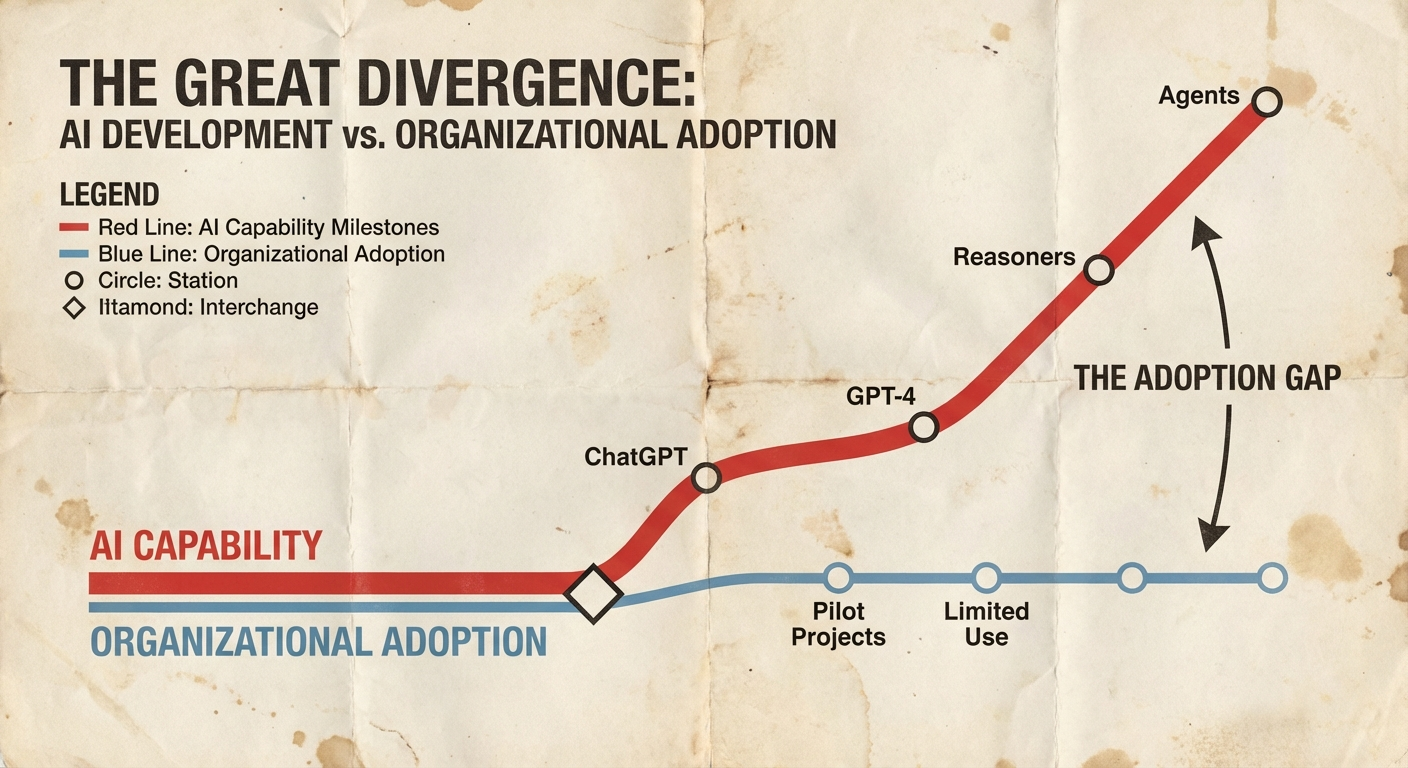
The 2025 productivity data suggests the J-curve turn has happened. Companies that invested in AI infrastructure 18-24 months ago are now seeing those investments show up in their operational metrics. The ones still running pilots are entering the investment phase just as early adopters are pulling away.
This post is based on The AI Productivity Boom Finally Shows Up from AI Daily Brief.