The Uncatchable Flywheel: Why Your AI Advantage (or Disadvantage) is Compounding Faster Than You Think

This post is inspired by the episode, Why AI Advantage Compounds of the AI Daily Brief. Here’s how it connects to Superintelligent:
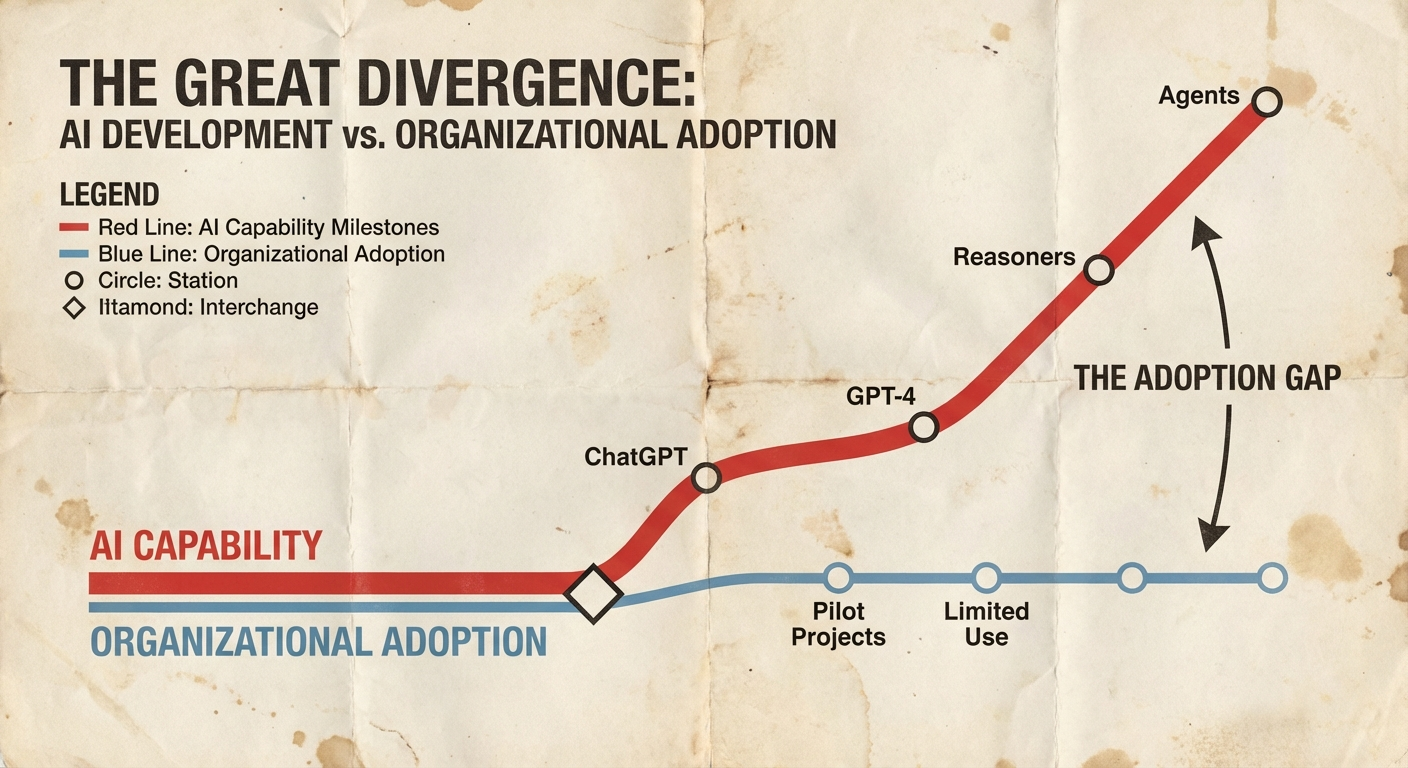
- The Compounding Gap: The compounding gap means the cost of inaction rises every quarter. SI helps organizations identify where they sit on the adoption curve and which use cases will close the gap fastest before it becomes insurmountable.
- ROI Comes From New Capabilities, Not Time Savings: If the highest ROI comes from new capabilities rather than efficiency, then the question changes from 'where can we save time?' to 'where are the biggest new opportunities?' That's exactly the use case discovery SI's audit provides.
The End of the AI Grace Period
As reported in the latest AI Daily Brief, we are witnessing a fundamental shift in the enterprise AI landscape. The era of casual experimentation is over. Data from multiple 2025 industry reports, including a pulse survey from EY and OpenAI's "State of Enterprise AI Report," confirms a stark reality: the AI rich are getting richer. Organizations that have moved beyond isolated pilots to deeply integrate AI into their core operations are not just seeing productivity gains; they are creating a compounding advantage that may soon be impossible for competitors to overcome.
From Productivity Gains to a Compounding Competitive Moat
Initial forays into AI often focus on a single, universal metric: time savings. Indeed, over 76% of organizations report time savings as a primary benefit of their AI initiatives. However, this is merely the entry point. The real, defensible advantage emerges as organizations climb the value chain. Research shows that the highest ROI is not found in saving time, but in achieving more strategic outcomes: improved decision-making, the creation of entirely new capabilities, and direct revenue growth.
This is where the flywheel effect kicks in. The EY survey reveals a critical behavior among AI leaders: they are not cashing out their productivity dividends. Instead, they are reinvesting them to pull further ahead. A staggering 96% of organizations seeing AI-driven gains are reinvesting them, not to reduce headcount, but to expand their AI capabilities (47%), develop new ones (42%), and fuel R&D (39%). This creates a virtuous cycle:
- Deeper Integration: AI leaders use their initial gains to fund the complex work of weaving AI into the fabric of the business, redesigning workflows, organizing data, and building the necessary infrastructure for more advanced, agentic AI systems.
- Structural Advantage: This infrastructure becomes a structural advantage. As noted by MIT's Center for Information Systems Research, the greatest financial impact comes from scaling AI from isolated pilots to enterprise-wide ways of working. This allows leaders to deploy more sophisticated AI agents that can handle complex, multi-step tasks, dramatically widening the performance gap.
- Market Reshaping: These structural advantages are then used to reshape markets. AI leaders can produce existing products and services faster, better, and cheaper. More importantly, their investment in R&D and new capabilities allows them to innovate entirely new product lines, creating revenue streams and competitive moats that laggards simply cannot access.
Key Questions for Your Leadership Team
The emergence of this compounding advantage forces a new level of strategic introspection. The question is no longer "Are we using AI?" but "Is our AI strategy building a defensible, compounding moat?" Here are the critical questions your leadership team should be debating:
- Beyond Time Savings: Are we measuring and managing our AI initiatives toward strategic ROI (e.g., improved decision quality, new revenue streams) or are we stuck at the surface level of productivity gains?
- The Reinvestment Mandate: Do we have a formal strategy for reinvesting the value generated by AI back into building deeper, structural capabilities, or are our gains evaporating into operational slack?
- Infrastructure for Agency: Is our current technology and data infrastructure capable of supporting the next wave of more autonomous, agentic AI, or are we building on a foundation that will limit our future ambitions?
- The Capability Gap: Are we systematically upskilling our workforce to move from simple AI use to complex, value-creating integration, or are we creating a two-tiered system of AI-haves and have-nots within our own organization?
- Competitive Moat or Sinking Ship?: When we look at our 3-year strategic plan, can we honestly say that our AI initiatives are building a compounding competitive advantage, or are we simply treading water while the leaders accelerate away?
How Leading Organizations Find Answers
The questions above can feel daunting, but they are not unanswerable. In our work with enterprise clients, we've observed a clear pattern: the organizations that successfully navigate AI transformation don't just buy technology; they build a strategic framework that aligns their people, processes, and data with their ambitions.
They move from ad-hoc exploration to a structured, holistic assessment of their capabilities. They create a common language for the executive team to debate and prioritize. Most importantly, they get an objective, data-driven baseline of where they are today before they try to build for tomorrow.
This is the philosophy we've codified into our AI Readiness Audit. It's not a product pitch; it's a diagnostic process designed to provide the objective clarity that leadership teams need to move forward with confidence. It allows organizations to systematically uncover their unique blockers and identify their highest-impact opportunities.
Continue the Conversation
Every organization's journey with AI is unique. If the questions and challenges discussed in this post resonate with your team, we welcome a conversation. Our goal is to help leaders build a clear, actionable roadmap.
To learn more about how a structured assessment can de-risk your AI investment and accelerate your path to value, you can explore our approach at besuper.ai or reach out to our team to discuss your specific situation.
References
[1] AI Daily Brief. (2025, December 11). Why AI Advantage Compounds. [Podcast]
[2] ALM Corp. (2025). OpenAI State of Enterprise AI Report 2025. Retrieved from https://almcorp.com/blog/openai-state-of-enterprise-ai-report-2025/
[3] Woerner, S. L., Sebastian, I. M., & Weill, P. (2025). Grow Enterprise AI Maturity for Bottom-Line Impact. MIT Sloan Center for Information Systems Research. Retrieved from https://cisr.mit.edu/publication/2025_0801_EnterpriseAIMaturityUpdate_WoernerSebastianWeillKaganer
This post is based on Why AI Advantage Compounds from AI Daily Brief.