Beyond the Hype: The Widening Gap in Enterprise AI and What It Means for Leaders

This post is inspired by the episode, Why AI Advantage Compounds of the AI Daily Brief. Here’s how it connects to Superintelligent:
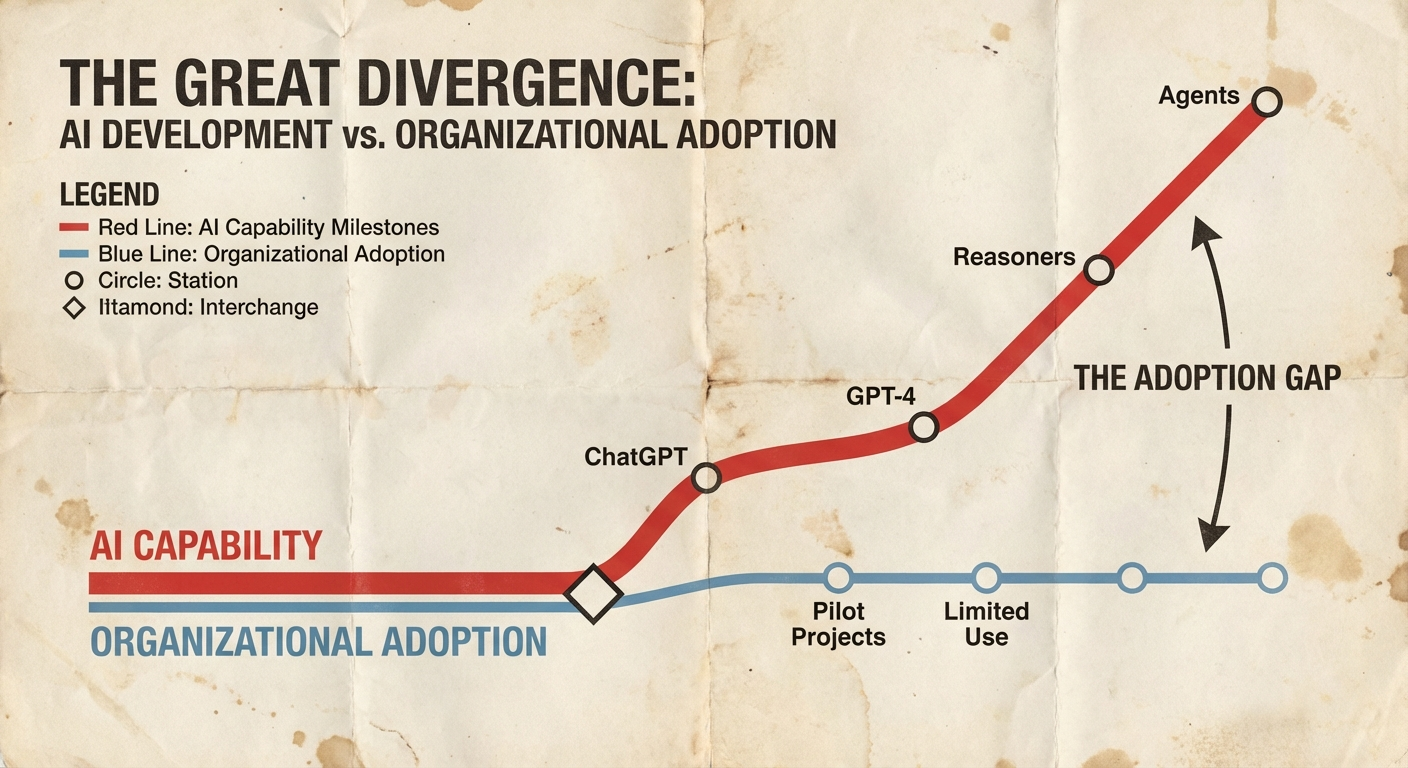
- The Compounding Gap: The compounding gap means the cost of inaction rises every quarter. SI helps organizations identify where they sit on the adoption curve and which use cases will close the gap fastest before it becomes insurmountable.
- ROI Comes From New Capabilities, Not Time Savings: If the highest ROI comes from new capabilities rather than efficiency, then the question changes from 'where can we save time?' to 'where are the biggest new opportunities?' That's exactly the use case discovery SI's audit provides.
The Market Has Spoken: AI Adoption Is Not a Fad, It's a Force
In the final weeks of 2025, the AI industry delivered a clear verdict on the state of enterprise adoption. As discussed on the AI Daily Brief, two landmark reports. OpenAI's "State of Enterprise AI" and Menlo Ventures' "Third Annual State of Generative AI in the Enterprise", painted a vivid picture of a market in hyper-growth [1] [2]. The data silences the bubble-or-boom debate, revealing that enterprise AI is not just a speculative bet but a rapidly maturing, multi-billion dollar reality.
Menlo Ventures reports that enterprise AI spending skyrocketed to $37 billion in 2025, capturing 6% of the global SaaS market in just three years [2]. OpenAI's data corroborates this, showing a 900% year-over-year increase in ChatGPT Enterprise seats and an 800% growth in weekly messages [1]. This isn't just broad, surface-level use; it's getting deeper. The use of custom GPTs and projects for repeatable, multi-step tasks is up an astonishing 19x, signalling a clear shift from simple prompts to integrated, automated workflows [1].
The Great Divide: Why "Doing AI" Isn't the Same as Leading with AI
The explosive growth numbers, however, mask a more critical and nuanced story: the emergence of a profound and widening gap between AI leaders and laggards. While over 70% of organizations have begun experimenting with AI, a far smaller cohort is achieving significant, scalable impact [3]. The top-performing firms aren't just using AI more; they are using it differently, and the results are creating a compounding competitive advantage.
OpenAI's report identifies a category of "frontier firms" that generate twice as many messages per seat and a staggering seven times as many messages to custom GPTs where contextual knowledge and workflows reside [1]. These organizations are systematically embedding AI as a core capability, not a peripheral productivity tool. This strategic commitment translates directly into superior performance. Research shows that AI leaders are achieving 1.7x higher revenue growth and 3.6x greater total shareholder returns [4].
The divide is also stark at the individual level. "Frontier workers", the top 5% of users, are not just more active; their usage patterns are qualitatively different. They send 17 times as many coding-related messages and 10 times as many analysis and calculation messages as their median peers [1]. This deeper engagement unlocks significant productivity gains, with these power users saving over 10 hours per week, a stark contrast to the minimal time savings reported by casual users. The message for leaders is clear: the value of AI is not in casual adoption but in deep, workflow-integrated application. The organizations that master this will not just be more efficient; they will be able to innovate faster, make smarter decisions, and attract and retain top talent in a virtuous cycle of performance.
The Litmus Test: Five Questions Separating AI Leaders from Laggards
As the gap widens, executive leadership teams must move beyond asking "if" they should adopt AI and start asking "how" they can lead with it. The following questions are not about technology; they are a diagnostic for strategic readiness. How your organization answers them will reveal whether you are on a path to leadership or at risk of becoming a laggard.
- Beyond Productivity, What New Capabilities Are We Building? While 75% of workers report productivity gains, the real transformation comes from doing what was previously impossible [1]. Are your teams just doing the same tasks faster, or are they using AI to analyze data in new ways, develop custom tools, and create entirely new value propositions?
- Is Our AI Strategy a C-Suite Conversation or a Series of Siloed Experiments? Frontier firms treat AI as a core organizational capability, not a collection of departmental tools [1]. Is your AI strategy integrated, governed, and sponsored from the top down, or is it a fragmented set of disconnected pilot projects with no clear path to scale?
- How Are We Measuring and Reinvesting the ROI from AI? Leaders who achieve 3-5x returns on AI projects reinvest those gains to fund further expansion [3]. Do you have a clear framework for measuring the financial impact of your AI initiatives, and a disciplined process for reallocating those returns to scale what works?
- Are We Building an Ecosystem or Just Buying Tools? The market has shifted decisively towards buying specialized AI applications, with startups now capturing the majority of revenue in the application layer [2]. Are you strategically assembling a cohesive ecosystem of best-in-class tools, or are you making ad-hoc purchasing decisions that create more complexity and data silos?
- Is Our Operating Model Evolving as Fast as the Technology? The most successful firms are investing systematically in the infrastructure, governance, and talent required to support AI at scale [1]. Are you adapting your organizational structure, data architecture, and risk management frameworks to not just support, but accelerate, your AI ambitions?
Building the Bridge from Ambition to Execution
The questions above can feel daunting, but they are not unanswerable. In our work with enterprise clients, we've observed a clear pattern: organizations that succeed don't just buy technology; they build a strategic framework first. They move from ad-hoc exploration to a structured, holistic assessment of their capabilities. They create a common language for the executive team to debate and prioritize. Most importantly, they get an objective, data-driven baseline of where they are today before they try to build for tomorrow.
This is the philosophy we've codified into our AI Readiness Audit, a diagnostic process designed to provide the objective clarity that leadership teams need to move forward with confidence. It's not a product pitch; it's a systematic methodology for uncovering an organization's unique blockers and identifying its highest-impact opportunities. It provides the data-driven foundation needed to build a realistic, actionable roadmap that closes the gap between AI ambition and execution.
Continue the Conversation
Every organization's journey with AI is unique. If the questions and challenges discussed in this post resonate with your team, we welcome a conversation. We read all our emails, ping me at danv@besuper.ai. Our goal is to help leaders build a clear, actionable roadmap. To learn more about how a structured assessment can de-risk your AI investment and accelerate your path to value, you can explore our approach at besuper.ai or reach out to our team to discuss your specific situation.
---
References
[1] OpenAI. (2025, December). The State of Enterprise AI 2025 Report. Retrieved from https://openai.com/index/the-state-of-enterprise-ai-2025-report/
[2] Menlo Ventures. (2025, December). 2025: The State of Generative AI in the Enterprise. Retrieved from https://menlovc.com/perspective/2025-the-state-of-generative-ai-in-the-enterprise/
[3] Lucidworks. (2025, November). Enterprise AI Adoption in 2026: Trends, Gaps, and Strategic Insights. Retrieved from https://lucidworks.com/blog/enterprise-ai-adoption-in-2026-trends-gaps-and-strategic-insights
[4] PwC. (2025, December). 2026 AI Business Predictions. Retrieved from https://www.pwc.com/us/en/tech-effect/ai-analytics/ai-predictions.html
This post is based on Why AI Advantage Compounds from AI Daily Brief.