Beyond the Hype: Why OpenAI's "Code Red" is a Wake-Up Call for Enterprise AI Strategy
This post is inspired by the episode, OpenAI Declares Code Red of the AI Daily Brief.
The AI Arms Race Just Went into Overdrive
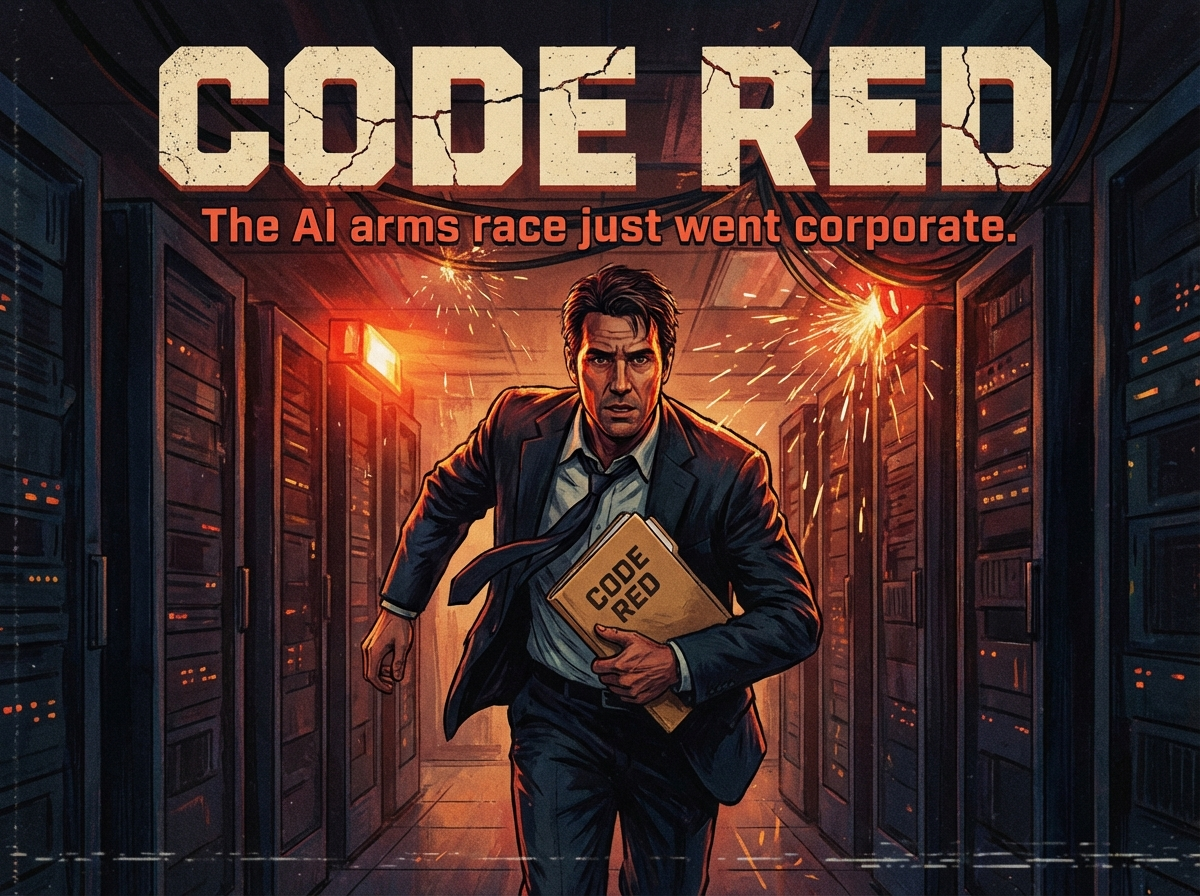
In early December 2025, a significant development rippled through the AI industry. OpenAI's CEO, Sam Altman, declared an internal "Code Red" to urgently refocus the organization's resources on improving its flagship product, ChatGPT [1]. This strategic pivot was a direct reaction to the perceived threat from Google's new Gemini 3 model, which had reportedly surpassed OpenAI's models in key performance benchmarks. The move, which involved pausing other initiatives like AI agents for shopping and health, underscores a dramatic escalation in the competitive landscape, shifting the focus from broad experimentation to a fierce battle for dominance in core AI capabilities.
From Inevitability to Instability: What the "Code Red" Means for Your AI Roadmap
The declaration of a "Code Red" at one of the industry's leaders is a seismic event with profound implications for enterprise leaders navigating their own AI journeys. The previous narrative of OpenAI's market inevitability has been replaced by a new reality of intense competition and rapid, reactive product cycles. This environment demands a more sophisticated approach to AI strategy, moving beyond the initial excitement of adoption to a more grounded assessment of risk, value, and long-term competitive advantage.
For organizations that have already integrated AI into their operations, this new phase introduces significant volatility. The accelerated release schedules and potential relaxation of safety protocols, driven by competitive pressure, mean that the risk profile of these powerful tools can change overnight. As one report noted, companies with deep integrations, such as Oscar Health and Intercom, now inherit a new level of uncertainty without an easy way to recalibrate [3]. This highlights a critical challenge for enterprise AI adoption: how do you build a stable, scalable strategy on a foundation that is constantly shifting? The answer lies not in chasing the latest model, but in developing a robust internal framework for evaluating, deploying, and managing these technologies at scale. This framework must prioritize business value and ROI over fleeting performance metrics, ensuring that AI investments are resilient to the turbulence of the market.
The competitive frenzy also complicates the evaluation of new AI capabilities. When vendors are locked in a feature war, it becomes increasingly difficult to distinguish between genuine breakthroughs and incremental improvements. Enterprise leaders must cultivate a discerning eye, focusing on how new capabilities translate into tangible business outcomes. Does a new model's enhanced reasoning ability solve a specific, high-value business problem? Or is it a marginal gain that offers little in the way of defensible competitive advantage? The ability to answer these questions accurately will separate the organizations that derive real value from AI from those that are simply caught in the hype cycle.
Are You Building on Bedrock or Quicksand?
The current AI landscape compels leadership teams to ask themselves a series of provocative questions. These are fundamental strategic diagnostics that reveal an organization's true readiness to compete and win in the age of AI.
- Is our AI strategy driven by a clear business thesis, or are we simply reacting to the latest market trends and vendor announcements?
- Do we have a rigorous, independent framework for evaluating the true ROI and risk profile of new AI models, or are we relying on vendor-supplied benchmarks?
- How are we building defensible value with AI that cannot be easily replicated by competitors who have access to the same underlying models?
- Is our organizational structure and talent pipeline prepared for the complexities of deploying and managing AI at scale, including the ethical and operational risks?
- Are we prepared to navigate a future where the dominant AI platforms may shift, and how would such a shift impact our current investments and roadmap?
Building a Strategic Framework for AI Success
In our work with enterprise clients, we've observed a clear pattern: organizations that succeed don't just buy technology; they build a strategic framework first. They approach AI not as a series of disjointed projects, but as a core business discipline that requires a structured, objective, and holistic approach. Answering the challenging questions above is the first step in building this discipline.
This is the philosophy we've codified into our AI Readiness Audit, a diagnostic process designed to provide the objective clarity that leadership teams need. It moves beyond the technical specifications of AI models to assess an organization's strategic, operational, and cultural preparedness. By evaluating everything from data infrastructure and talent to business model alignment, a structured assessment provides a clear, actionable roadmap for de-risking AI investments and accelerating the path to value.
Your AI Journey is Unique. Your Strategy Should Be Too.
Every organization's journey with AI is unique. If the questions and challenges discussed in this post resonate with your team, we welcome a conversation. We read all our emails and welcome conversation-ping me at danv@besuper.ai. Our goal is to help leaders build a clear, actionable roadmap. To learn more about how a structured assessment can de-risk your AI investment and accelerate your path to value, you can explore our approach at besuper.ai or reach out to our team to discuss your specific situation.
---
References
[1] AI Daily Brief. (2025, December 2).
[2] The Wall Street Journal. (2025, December). OpenAI CEO Declares 'Code Red' Over ChatGPT. [https://www.wsj.com/tech/ai/openais-altman-declares-code-red-to-improve-chatgpt-as-google-threatens-ai-lead-7faf5ea6]
[3] Computerworld. (2025, December 10). What does OpenAI's 'Code Red' warning mean for Microsoft?. [https://www.computerworld.com/article/4103345/what-does-openais-code-red-warning-mean-for-microsoft.html]
[4] SalesforceBen. (2025, December 5). What Does Sam Altman's "Code Red" With ChatGPT Say About OpenAI's Future Progress?. [https://www.salesforceben.com/what-does-sam-altmans-code-red-with-chatgpt-say-about-openais-future-progress/]
This post is based on OpenAI Declares Code Red from AI Daily Brief.